

Senoia Area Historical Society Spotlight: Uncovering the Civil War and Agricultural Roots of Senoia, GA
Walk through downtown Senoia today and it's easy to see why so many people are drawn to the community.
Historic homes line quiet streets. Locally owned businesses occupy charming storefronts. The downtown district has a distinctly small-town character, and many of the buildings and streetscapes provide a visual connection to earlier generations.
But the story of Senoia, Georgia, goes much deeper than its picturesque downtown.
Long before Senoia became a popular destination for visitors, a growing community for families relocating south of Atlanta, or a recognizable filming location, the area was shaped by agriculture, transportation, railroads, migration, and the enormous disruption of the Civil War.
Today, the Senoia Area Historical Society plays an important role in preserving that story.
Established in 1977, the Society's mission is to secure, preserve and promote the social and cultural history of the Senoia community. Its work includes maintaining historic properties and collections, researching and publishing historical records, identifying significant places and structures, and educating the public.
For anyone interested in Senoia GA history, the Society offers an opportunity to look beyond the modern community and understand the people, businesses, farms, transportation networks and events that helped create the Senoia we know today.
Where Did Senoia Begin?
To understand Senoia, it helps to go back before the town officially carried the name.
Coweta County was established in 1825, and settlers began moving into the region during the years that followed. The City of Senoia's official history notes that land in what became the community was distributed through Georgia's land lottery system, and settlers arrived from places including Newberry, South Carolina.
These early settlers included farmers, tradespeople, religious leaders and other members of the community.
Agriculture quickly became central to life in the area.
The rich land of eastern Coweta supported crops and livestock, with cotton, corn and livestock among the important agricultural products of the early community.
This agricultural foundation is essential to understanding why Senoia developed where it did.
The town wasn't created in isolation.
It grew out of a broader rural landscape where farms and families were connected by roads, churches, markets and eventually railroads.
The Communities Before Modern Senoia
The community that eventually became Senoia went through several stages of development.
One early settlement was known as Location, approximately two miles south of present-day Senoia.
Another community called Willow Dell emerged in the 1850s.
Then, in 1860, the Rev. Francis Warren Baggarly purchased land where the modern town developed.
That date is particularly significant because it places Senoia's formal beginnings immediately before one of the most consequential periods in American history.
The Civil War began in 1861.
Senoia and the Civil War Era
When discussing Senoia GA Civil War history, it's important to understand the distinction between what happened directly in Senoia and what happened throughout the surrounding Coweta County region.
Senoia was a young community during the Civil War.
The city was officially incorporated in December 1866, shortly after the war ended. The settlement's early development therefore unfolded against the backdrop of a region experiencing enormous political, economic and social upheaval.
The City of Senoia's history records an especially interesting connection to the Confederacy.
One of the community's earliest structures, known as the Rock House, was originally intended for mercantile purposes. As the war developed, it became a commissary for the Confederacy.
The same building also served another important community role.
The first Methodist Episcopal church and Sunday school were organized upstairs, and a high school opened in 1865.
That combination tells us something important about the early community.
Even during an extraordinarily difficult period, Senoia was developing institutions that would help establish it as a permanent town.
The Civil War in the Coweta County Region
Senoia's story cannot be separated from the larger history of Coweta County.
By 1860, Coweta County had grown to nearly 15,000 residents, with agriculture serving as a major source of income. Plantations and farms dominated the economy, and the Civil War brought profound changes to the region.
One of the most significant nearby Civil War events was the Battle of Brown's Mill, fought in Coweta County on July 30, 1864.
The battle occurred near Newnan rather than in downtown Senoia, but it illustrates the military importance of the broader region during the Atlanta Campaign.
Union cavalry under Brigadier General Edward McCook had been conducting a raid intended to disrupt Confederate railroad and supply lines. Confederate cavalry under Major General Joseph Wheeler eventually caught McCook's forces near Brown's Mill, resulting in a Confederate victory. The Georgia Historical Society notes that McCook's raid involved an effort to destroy railroads south of Atlanta and reach Andersonville.
Today, the Brown's Mill battlefield is preserved as a historic site near Newnan.
For people researching Coweta County Civil War history, it is an important reminder that the rural communities surrounding Senoia were part of a much larger military and transportation landscape.
Why Railroads Changed Senoia
If agriculture was the economic foundation of early Senoia, railroads helped transform the community.
Two intersecting railroad routes played a major role in determining the town's location and development. The City of Senoia identifies transportation connections as a major reason the community grew where it did.
After the Civil War, the Savannah, Griffin and North Alabama Railroad crossed through Senoia.
That created an important connection between local farms and larger markets.
Agricultural products including cotton and peaches could be shipped by rail from Senoia.
The railroad wasn't simply a transportation convenience.
It influenced where businesses located.
It helped farmers move products.
It brought materials into the community.
And it contributed to the growth of downtown Senoia.
The National Register documentation for the Senoia Historic District identifies transportation and communications as significant areas of the district's history. It also documents the development of residential areas around the historic business district and railroad-related industrial areas.
Agriculture Was the Backbone of Early Senoia
Today, someone searching for Senoia GA real estate may be thinking about neighborhoods, new construction, restaurants, schools and commute times.
But for generations, land was primarily viewed through an agricultural lens.
Cotton was important.
Corn was important.
Livestock was important.
And later, peaches became a notable agricultural product shipped through Senoia by rail.
This agricultural history helps explain why the community developed a landscape of farms and larger parcels surrounding its central town.
It also helps explain why today's Senoia-area acreage can feel so different from denser suburban communities closer to Atlanta.
The rural landscape is not a recent invention.
It is part of the area's historical identity.
The Senoia Area Historical Society: Preserving the Story
The Senoia Area Historical Society was founded in 1977 following local efforts surrounding the United States Bicentennial.
According to the Society, leftover funds from the community's 1976 Bicentennial celebration—$55.89—became seed money for the organization that followed. The Society incorporated as a nonprofit in 1980.
That local beginning eventually developed into a significant preservation organization.
One of its most important achievements came in 1989, when the Society helped complete the work required to place Senoia's historic district on the National Register of Historic Places.
That preservation work has helped maintain a visible connection between modern Senoia and the generations that came before it.
Visit the Senoia History Museum
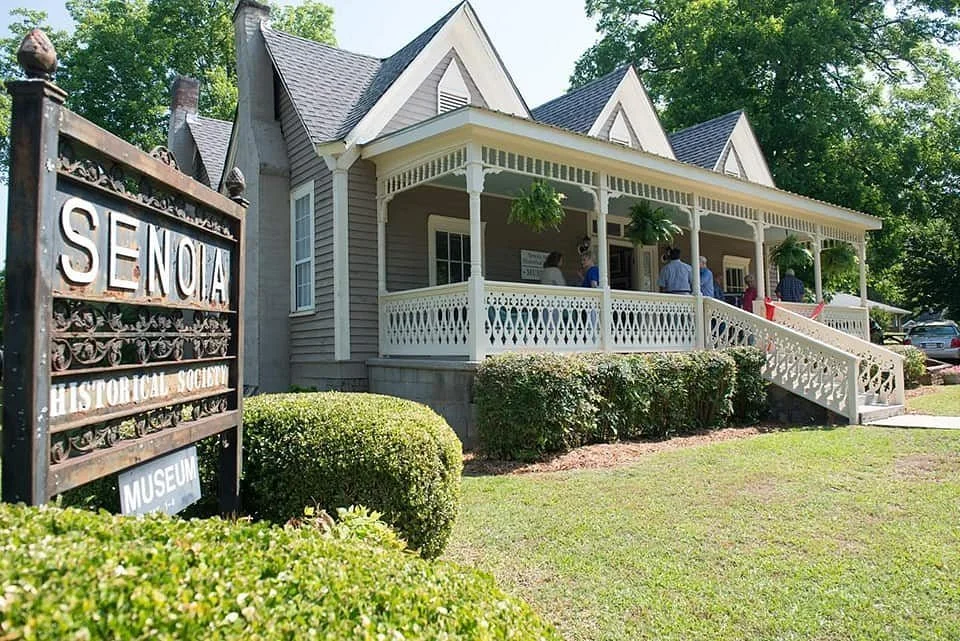
One of the best ways to explore Senoia GA history is to visit the Senoia Area Historical Society Museum at 6 Couch Street.
The museum is housed in the historic Carmichael House, which the Society purchased in 1990. The building opened to the public as the Senoia History Museum in 2010.
Current museum information lists regular hours on Saturday and Sunday from 1:00 p.m. to 4:00 p.m. at 6 Couch Street. Visitors should verify hours before making a special trip because museum schedules can change.
The museum contains artifacts and records that bring local history to life.
Among the collections are:
Early land documents
Historic maps
Banking artifacts
School memorabilia
Photographs
Personal belongings
Community records
Local publications
Research materials
The City of Senoia's museum page specifically notes original land lottery deeds dating to the 1820s, ration coupon books, artifacts from the 1874 Farmers & Merchants Bank, school newspapers, diplomas and photographs.
For someone who wants to understand how Senoia evolved from an agricultural settlement into a modern community, these objects can tell a story that statistics alone cannot.
Senoia's Digital Historical Archive
The Historical Society's preservation efforts aren't limited to the museum.
The Society also maintains a digital archive containing historical documents, photographs, stories, artifacts and information about local people and organizations.
The archive includes primary sources such as:
Letters
Ledgers
Meeting minutes
Local government records
Photographs
Historic artifacts
Information about businesses
Church records
School history
Civic organizations
For genealogy researchers and families who have lived in Coweta County for generations, resources like these can be especially valuable.
For newcomers, they provide a fascinating introduction to the community they now call home.
Senoia's Historic District
One of the most visible reminders of the city's past is the Senoia Historic District.
The district was added to the National Register of Historic Places in 1989. The National Park Service identifies architecture, transportation and communications as areas of significance, with a period of significance spanning multiple eras from 1825 through 1949.
The district includes a collection of architectural styles and historic structures associated with the community's development.
The National Register documentation identifies styles including:
Queen Anne
Greek Revival
Classical Revival
It also describes residential development around the central business district and railroad-related areas.
That architectural history is one reason walking through downtown Senoia can feel different from visiting a newer suburban commercial district.
The buildings aren't simply decorative.
They are physical records of how the community grew.
National Register vs. Local Historic Preservation
This is an important distinction for anyone considering a historic home in Senoia GA.
Being listed on the National Register of Historic Places does not automatically mean that a privately owned property is frozen in time.
The Georgia Department of Community Affairs explains that National Register listing itself does not impose restrictions on the use, treatment, transfer or disposition of private property.
However, Senoia also has a local historic preservation framework.
The city's Historic Preservation Commission works to preserve, rehabilitate, restore and reconstruct historic properties in the local historic district. The city says new construction within the district should complement rather than damage the historic character of the neighborhood.
For homeowners, that distinction matters.
If you're considering buying a historic property, understand whether it is simply located within a National Register district or whether it is also subject to local historic preservation regulations.
Why Senoia's History Matters to Today's Homebuyers
History may seem unrelated to real estate.
In Senoia, it isn't.
The same characteristics that shaped the community historically continue to influence why people are interested in living here today.
Consider the connections.
Agriculture created the surrounding rural landscape.
Today, buyers are attracted to Senoia's larger lots, acreage properties and open spaces.
Railroads helped create the downtown.
Today, downtown remains one of Senoia's most recognizable community destinations.
Historic architecture established a sense of place.
Today, historic homes and buildings contribute to the community's character.
Local businesses grew around the town center.
Today, residents and visitors enjoy restaurants, boutiques and services in the downtown area.
Community institutions developed early.
Today, organizations like the Senoia Area Historical Society continue to preserve and strengthen the community's identity.
History isn't simply something that happened to Senoia.
It helped create the place people are choosing to live in today.
Things to Do in Senoia GA for History Lovers
If you're researching things to do in Senoia GA, consider creating your own local history tour.
Start at the Senoia History Museum
Spend time exploring the Carmichael House and the Society's collections.
Walk the Historic District
Look at the architecture and imagine how the town developed around its railroad and commercial center.
Explore Downtown Senoia
Visit local restaurants, shops and businesses while seeing historic buildings up close.
Study Historic Maps
The museum's collections include large historic maps, including an 1898 map that provides an interesting comparison with later maps of the town.
Explore Coweta County Civil War History
For a broader understanding of the Civil War's impact on the region, visit nearby Brown's Mill Battlefield outside Newnan.
Research Your Own Family History
The Historical Society's digital archive can be a starting point for researching local people, organizations and historic documents.
Why Senoia's Agricultural Roots Still Matter
One of the most interesting aspects of Senoia is how much of its agricultural identity remains visible even as the community grows.
Drive beyond the downtown core and you'll encounter larger parcels, wooded properties, open land and rural roads.
That landscape provides a connection to the community's past.
It also contributes to the appeal of Senoia GA homes with acreage and properties outside the more concentrated neighborhoods.
For buyers who are moving to Senoia GA from Atlanta or another metropolitan area, this can be a major lifestyle attraction.
You can have more space while remaining connected to the broader Atlanta region.
Of course, growth is changing portions of the community, which makes thoughtful planning and historic preservation increasingly important.
Preserving Senoia While Planning for the Future
Every growing town faces a balancing act.
How do you welcome new families and businesses while protecting the characteristics that made the community attractive in the first place?
Senoia's answer includes historic preservation, community planning and organizations such as the Senoia Area Historical Society.
The Society's mission specifically includes identifying and encouraging preservation of significant places and structures throughout the community.
The city's Historic Preservation Commission also works to ensure development within the historic district respects the established character of the area.
That doesn't mean Senoia can't grow.
It means growth happens within a community that has a story worth protecting.
What Senoia History Can Teach Newcomers
If you're a newcomer, you don't have to be a lifelong historian to appreciate Senoia.
Start with one simple question:
"What was here before me?"
Look at the old homes.
Look at the railroad corridors.
Learn about the farmers who shaped the area's economy.
Study the maps.
Visit the museum.
Read the old records.
Learn about the Civil War's impact on Coweta County.
And talk with longtime residents.
You'll begin to understand that Senoia isn't simply a newer Atlanta suburb.
It's a community with roots that reach back nearly two centuries.
Senoia's Story Is Still Being Written
The history of Senoia didn't end when the railroads arrived.
It didn't end when the town was incorporated.
And it certainly didn't end in the twentieth century.
The community continues to evolve.
New families are moving in.
Businesses are opening.
Historic properties are being preserved.
New homes are being built.
And the city continues to consider how to accommodate growth while protecting its character.
That makes organizations like the Senoia Area Historical Society especially important.
By preserving documents, photographs, artifacts, buildings and stories, the Society gives future generations the opportunity to understand where Senoia came from.
Final Thoughts: Discover the History Behind Senoia GA Real Estate
When you're searching for Senoia GA homes for sale, it's easy to focus on bedrooms, bathrooms, square footage, lot size and price.
But there is another feature that doesn't show up in an MLS data sheet:
A property's connection to the history of the community.
Senoia's agricultural roots, railroad history, Civil War-era story and historic architecture all contribute to the identity of the town.
The Senoia Area Historical Society helps preserve that identity by collecting and sharing the records and artifacts that tell the community's story.
For longtime residents, the Society helps preserve memories.
For history lovers, it offers a fascinating look into the past.
And for people moving to Senoia GA, it provides a chance to understand the community beyond the modern streetscape.
The next time you're walking through downtown Senoia, take a closer look.
The historic buildings aren't simply beautiful.
The railroad wasn't simply transportation.
The farmland wasn't simply empty land.
And the stories preserved by the Historical Society aren't simply old documents.
Together, they explain how Senoia became the community it is today.
Thinking About Buying or Selling Senoia GA Real Estate?
Whether you're looking for a historic home, new construction, acreage, an investment property or one of the best areas to live in Senoia GA, local knowledge matters.
Tim Stout Group with eXp Realty can help you understand not only the Senoia GA real estate market, but also the neighborhoods, properties and community characteristics that make each location unique.
If you're buying, selling, relocating or investing in Senoia and the surrounding Coweta County area, let's help you make the right move—fast, profitable, and stress-free—in Senoia, GA real estate.
Posted by Tim Stout — Top producing Realtor & Real Estate Investor in Senoia. I help families buy, sell, and navigate real estate with ease. Tim@mybrokerage.com
